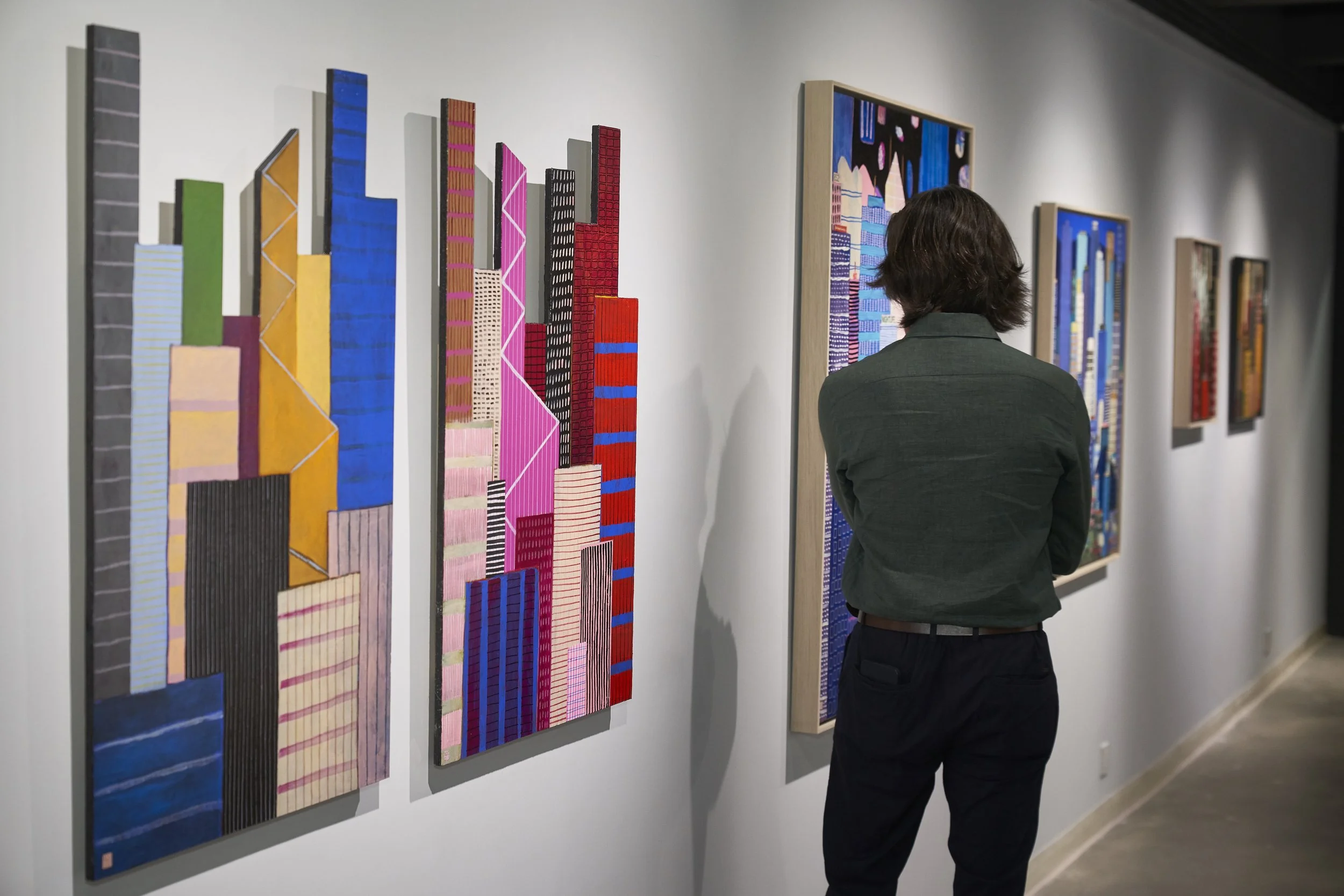
Francesco Lietti is an Italian artist based in Hong Kong whose work explores the relationship between urban environments, spatial perception, and material construction.
Born in Lecco, on the southern shore of Lake Como, Italy, Lietti studied architecture in Milan before continuing his education in Paris at the École des Beaux-Arts La Seine. He later completed a postgraduate diploma in Urban Planning at London South Bank University. Prior to dedicating himself full time to his artistic practice, he worked as an architect in London with Denton Corker Marshall and Gustafson + Porter, and later in Hong Kong with Aedas, where he has lived and worked for many years.
Painting has remained a constant throughout his professional and creative journey. For more than twenty-five years, Lietti has developed a visual language shaped by layering, fragmentation, rhythm, and structural composition, drawing from both direct observation and his experience of architecture and urban space.
His early work focused primarily on the visual and experiential dimension of cities, translating dense urban environments into compositions that move between representation and abstraction. Over time, his practice has evolved toward a more distilled and reflective direction. While retaining elements of his established vocabulary, his recent work increasingly investigates the underlying systems, structures, and spatial conditions that shape contemporary environments.
The city itself has become less a subject to depict and more a starting point for exploring how places are organised, layered, compressed, and experienced. Working across painting, collage, and mixed-media processes, Lietti develops compositions that balance architectural structure with atmospheric presence. His more recent works introduce greater material depth and spatial complexity through layered surfaces and sculptural construction, extending the dialogue between painting and physical space.
Living and working in Hong Kong continues to play a significant role in shaping this evolution. The city's density, verticality, and coexistence of natural and built environments inform a practice centred on spatial tension, adaptation, transformation, and the experience of contemporary space.
Lietti's work has been exhibited internationally across Asia, Europe, and the United States, and includes artist residencies, commissioned projects, and collaborations with private collectors, luxury brands, and corporate organisations. His works are held in private and corporate collections worldwide, including Louis Vuitton, Cushman & Wakefield, T. Rowe Price, EFG International, and others.